Skeletal
The skeletal system forms the rigid internal framework of 206 bones, associated cartilages, and synovial articulations protecting vital organs, facilitating locomotion, and housing hematopoiesis.
Quantitative Metrics & Physiological Scale
Standard adult osseous framework (excluding accessory sesamoids)
Cranial, spinal, rib cage, and sternal central support bones
Pectoral and pelvic girdles plus bilateral upper and lower limbs
Hydroxyapatite crystal reservoir mobilized by PTH and calcitonin
Physiological Role & Homeostasis
Structural scaffold supporting soft tissue cavities and locomotion lever systems
Rigid protective cages safeguarding the central nervous system and thoracic viscera
Red bone marrow hematopoiesis producing all circulating blood cell lineages
Axial Skeleton vs Appendicular Skeleton
| Feature / 比较维度 | Axial Skeleton / 中轴骨 (80 块) | Appendicular Skeleton / 附肢骨 (126 块) |
|---|---|---|
| Anatomical Constituents / 包含主要骨骼 | Cranium (22), Vertebrae (26), Ribs (24), Sternum (1), Hyoid (1) / 颅骨(22)、脊柱(26)、肋骨(24)、胸骨(1)、舌骨(1) | Pectoral girdle (4), Upper limb (60), Pelvic girdle (2), Lower limb (60) / 上肢带骨(4)、上肢骨(60)、下肢带骨(2)、下肢骨(60) |
| Core Biomechanical Role / 核心力学功能 | Vertical weight-bearing, posture axis & protective visceral cavities / 身体纵轴垂直承重、重力支撑与中枢/胸腹脏器庇护 | Locomotion, spatial manipulation & multidirectional limb reach / 空间位移移动、抓握取物精细操作与大范围自由度活动 |
| Mobility vs Stability / 关节活动度与稳定性平衡 | Prioritizes mechanical rigidity & shock absorption (discs) / 强调刚性承载与稳定性(椎间盘提供适度微动缓冲) | Prioritizes high angular freedom (ball-and-socket, saddle joints) / 强调大范围活动度(如肩关节球窝与拇指腕掌关节) |
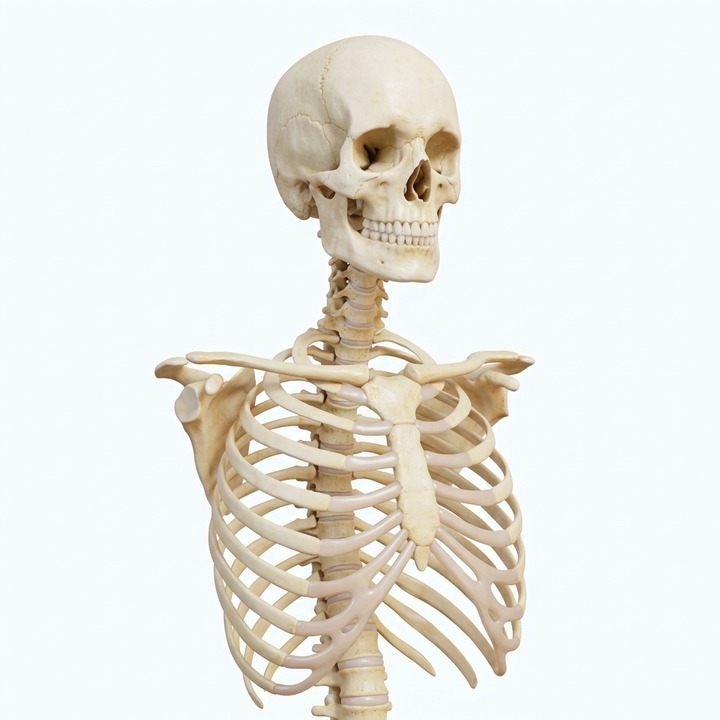
Full 3D Atlas Coverage
This system is fully interactive in the 3D Full-Body Atlas with complete anatomical parts, layer visibility toggling, and exploded view.
How to Study This System in 3D
Use the exploded view slider to separate the cranial bones, revealing internal fossae and skull base foramina.
Overlay the Muscular system to identify osseous tuberosities and ridges serving as muscle origins and insertions.
Explore Synergistic Anatomical Systems
For educational use only; not medical advice, diagnosis, or treatment.