Sensory Organs
The sensory system encompasses specialized sensory organs including visual, auditory, olfactory, gustatory, and vestibulocochlear apparatus converting environmental stimuli into nerve impulses.
Quantitative Metrics & Physiological Scale
Specialized rod and cone cells capturing photons
Four recti and two oblique muscles steering ocular gaze
Malleus, incus, and stapes amplifying acoustic waves
Acoustic frequency tonotopic transducers in organ of Corti
Physiological Role & Homeostasis
Optical focusing, refraction, and phototransduction into visual evoked potentials
Tympanic mechanical vibration impedance matching and acoustic frequency discrimination
Semicircular canal angular acceleration and otolith linear gravity detection
Photoreceptor Comparison: Rods vs Cones
| Feature / 比较维度 | Rod Cells / 视杆细胞 | Cone Cells / 视锥细胞 |
|---|---|---|
| Light Sensitivity / 感光敏感度阈值 | Extremely high (scotopic / dim night vision) / 极高敏感度(单光子激发;负责夜视与暗视) | Lower sensitivity (photopic / daylight vision) / 较低敏感度(强光激活;负责明视与精细辨析) |
| Color Discrimination / 色觉辨别能力 | Monochromatic (grayscale; no color perception) / 单色灰度(无色彩解析力,主要含视紫红质) | Trichromatic (Red, Green, Blue opsins) / 三原色色觉(红、绿、蓝三种光敏色素视蛋白) |
| Retinal Distribution / 视网膜空间分布 | Widely distributed across peripheral retina / 广泛密集分布于视网膜周边部 | Heavily concentrated in fovea centralis of macula / 极度集中汇聚于黄斑中央凹,提供最高视力锐度 |
Vital Organs & Structures
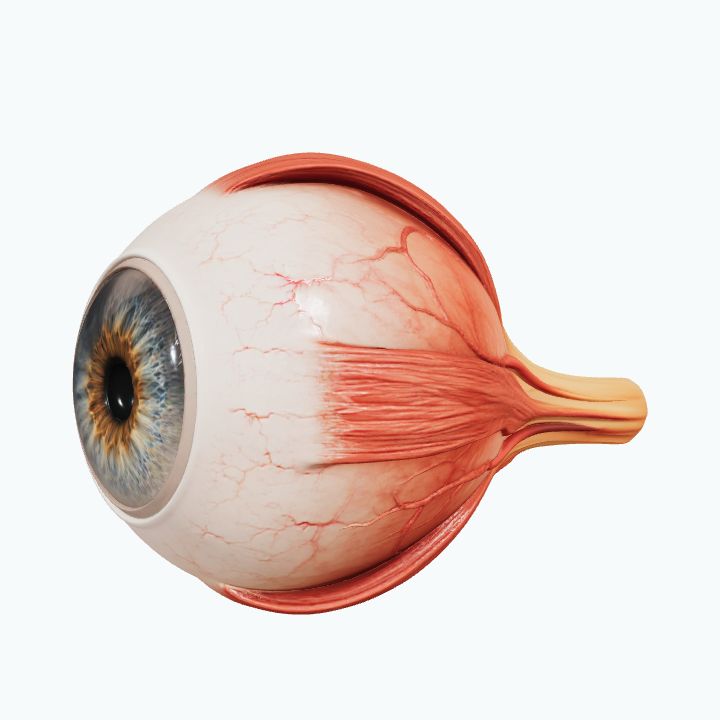
How to Study This System in 3D
Isolate the eyeball to observe corneal curvature, sclera, and optic nerve projection.
Combine with the Nervous system to trace how sensory cranial nerves communicate with the brainstem.
Explore Synergistic Anatomical Systems
For educational use only; not medical advice, diagnosis, or treatment.